Hot water rising: climate change’s impact on fisheries (and what to do about it)

By David Kaczan, Fegi Nurhabni, and William Cheung

First published on Development and a Changing Climate (World Bank blog), April 29, 2024. Available in English and Bahasa Indonesia.
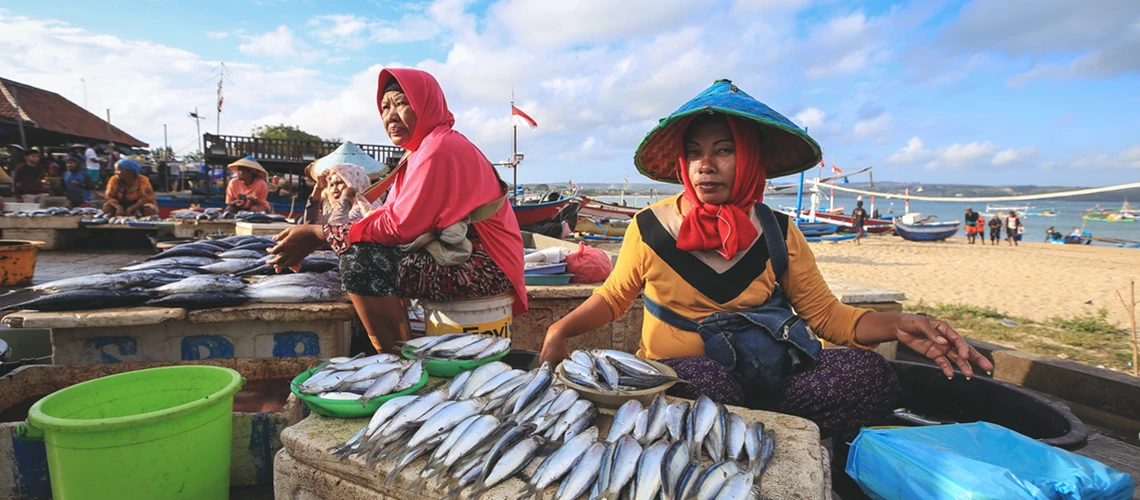
Fishmongers selling fish at the Kedonganan Fish Market, in Bali, Indonesia.Kedonganan Fish Market, Bali, Indonesia. Photo: freepik.com

Oceans have absorbed more than 90 percent of the global warming that has occurred over the past 50 years. For that, humanity has much to be thankful. This heat absorption has protected us from even larger shifts in the earth’s temperature.

However, the oceans are not immune to the effects of this accumulating heat. Rising water temperatures are impacting fisheries, intensifying storms, raising sea levels, and causing shifts in coastal ecosystems. With over 300 million people worldwide dependent on fisheries for their livelihoods and more than 3 billion people relying on seafood for their protein intake, the impact of climate change on oceans is significant.

World Bank analysis, undertaken in partnership with the University of British Columbia and government counterparts in several countries, is quantifying these impacts. It predicts that the fishery catch potential of many African countries, including the Democratic Republic of Congo, Côte d’Ivoire, Equatorial Guinea, Gabon, Liberia, and São Tomé and Príncipe, could decrease by 30 percent or more by 2050. Similarly in Indonesia, the catch potential of important commercial species, including Bali sardinella, torpedo scad, mackerel, and skipjack tuna, could decline by 20-30 percent in the same timeframe (Figure 1).   
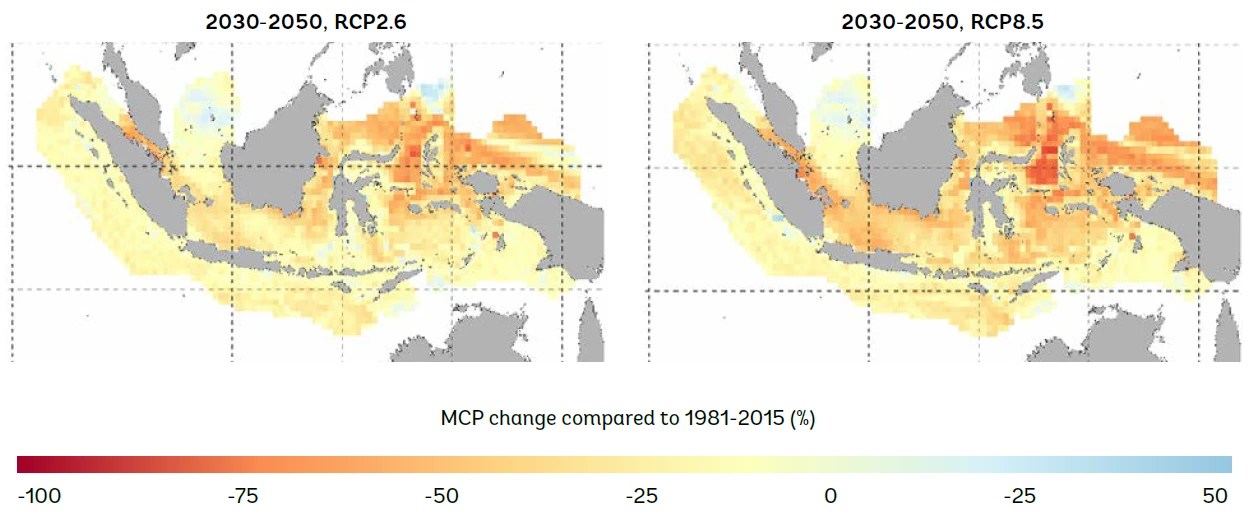
The projected catch of fish species in Indonesian waters under climate change

Figure 1: The projected catch of fish species in Indonesian waters under climate change. The projected change in the catch of fish volume in Indonesian waters (MCP = maximum catch potential) by mid-century (2030-50) under low (RCP2.6) and high (RCP8.5) climate change scenarios. Source:  Hot Water Rising: The Impact of Climate Change on Indonesia’s Fisheries and Coastal Communities.

Our recently published report, “Hot Water Rising: The Impact of Climate Change on Indonesia’s Fisheries and Coastal Communities”,  jointly prepared by the World Bank, the Indonesian Ministry of Marine Affairs and Fisheries, and the University of British Columbia, and supported by PROBLUE and the Packard Foundation, unpacks these challenges and provides options for adaptation.

Total economic returns in the fishery sector are projected to decrease by between 15 and 26 percent under low emission and high emission scenarios across the Indonesian exclusive economic zone by 2050, in the absence of adaptation measures. These impacts would be critical to Indonesia, where fisheries contribute more than $27 billion annually to the economy, supplying half of the country’s protein intake and supporting over 7 million jobs.

Total economic returns in the fishery sector are projected to decrease by between 15 and 26 percent under low emission and high emission scenarios across the Indonesian exclusive economic zone by 2050, in the absence of adaptation measures.

However, the report also shows that strong fisheries management can help offset climate change-related losses. For instance, preventing overfishing (by maintaining total fishing effort at 80 percent of the maximum sustainable yield), would mitigate losses in the large-scale fishing sector, with economic returns projected to be 4-6 percent greater than those received today. In the small-scale sector, preventing overfishing would reduce economic losses from a predicted 17-19 percent to 9-10 percent (Figure 2). The difference between these sectors is a function of the fish species caught by each sector.
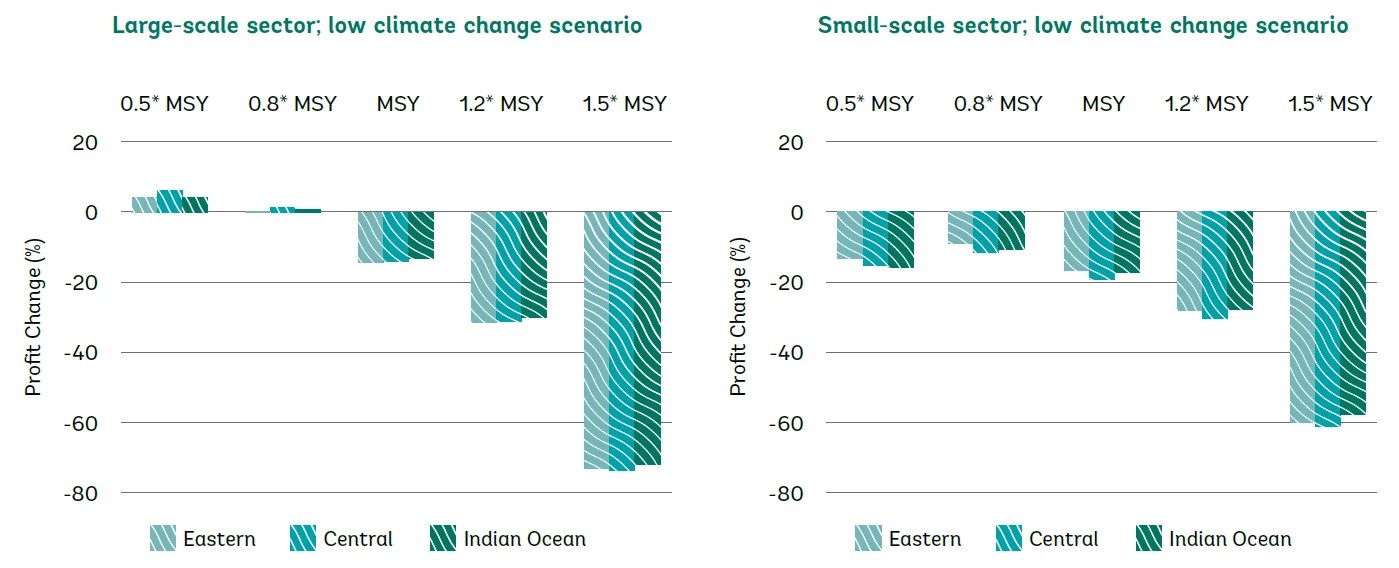
The projected change in economic returns for small-scale and large-scale fishing sectors.

Figure 2: The projected change in economic returns for small-scale and large-scale fishing sectors (defined by vessel size below and above 10 gross tonnes respectively). Percentage change in economic returns (revenues less costs) by 2050 relative to current returns. Source:  Hot Water Rising: The Impact of Climate Change on Indonesia’s Fisheries and Coastal Communities.

The report identifies three strategic interventions that can further lessen the impacts of climate change on fisheries and coastal communities:

  1. Strengthened fisheries management. Strong fisheries management is the first line of defence against climate change, keeping fish populations at healthy levels to ensure a buffer against climate impacts. Indonesia aims to operationalize a decentralized fishery management system that can provide localized and responsive management. This includes quota-based fishing, which allows greater flexibility on when and how much is harvested, within a set limit. Other measures such as expanded use of vessel monitoring systems could help improve safety-at-sea and provide data to aid fisheries management decisions. Rapid and targeted fishery closures (“dynamic management”) could be used to reduce the pressure on fisheries during marine heatwaves.
  2. Protected coastal ecosystemsHealthy ecosystems are the foundation of a climate-resilient ocean economy. An expansion of Marine Protected Areas, with a focus on high-biodiversity locations, fish nursery grounds, and upgrades to management capacity, is required globally. Protection of coastal mangroves is also critical, given their role in protecting erosion-prone coastlines and supporting fisheries. Integrating mangroves into the national REDD+ framework to facilitate carbon financing would help. Introducing standardized sampling protocols for coral reefs, mangroves, and seagrasses would enhance systematic monitoring – a key part of management. Indonesia provides a good example of a country investing in ocean ecosystems through the World Bank-financed Oceans for Prosperity (Lautan SejahteraLAUTRA) Project, and the Mangroves for Coastal Resilience Project.
  3. Empowered coastal communities. Ensuring communities have diverse economic opportunities is critical to long-term adaptation, providing security and incentives for people to transition to new sectors. This means a holistic approach to providing finance, business skills, and access to markets to support business growth and reduce reliance on fisheries. Coupled with social protection systems and climate-insurance (which could be tailored to cover fishers’ losses from storms or marine heatwaves), these can provide an additional layer of support.

Ultimately, climate resilience cannot be considered separately from the development needs of coastal communities. The improvement of fishers’ income and safety, stock productivity, and economic diversification are intertwined with climate and development goals. Measures such as these can enable coastal communities to survive a changing climate in Indonesia and around the world.
Catch Shares Slow the Race to Fish: New Paper in Nature

SONY DSC

With co-authors Anna Birkenbach and Marty Smith, I show that catch shares slow the “race to fish” (blog also published at env-econ)

Economists regularly turn to one famous example when making the case for property rights in fisheries: Alaskan halibut.

In the early 1990s, the halibut derby was madness. At the approved moment, thousands of boats would race each other out of Alaskan harbors. They would spend a short designated period, just a few days, battling dicey weather in the Gulf of Alaska, dropping as many lines as their crew could handle, and filling their holds to the brim. For those who were successful, this race offered the riches of a gold rush. For those left behind, it was an expensive exercise in sleeplessness and danger.

As class after class of natural resource economics students learns, this crazy dash was a classic tragedy of the commons. Fishers competed with each other to secure as much of the catch for themselves as they could. And they were also racing the authorities. As soon as the season’s total allowable catch was reached – often just 24 hours after starting – the fishery was closed to preserve stock for the following year.

Starting in 1994, individual rights to specified proportions of the total allowable catch – “catch shares” – were allocated to fishers. The need to race was mitigated. Today the season is a relatively calm, months-long endeavor.

Not surprisingly, given anecdotes like this, economists have long felt themselves on secure ground when advocating for catch shares in fisheries management. Yet despite wide acceptance, the hypothesis that catch shares slow the race to fish has not been systematically tested across fisheries.

In a paper published in Nature this month, we attempt to fill that gap. Our analysis is broad and conceptually simple: we consider every U.S. fishery that underwent a transition to catch share management and for which monthly data are available (N=39). Using a difference-in-differences strategy, we compare the season length changes in catch share-treated fisheries to those in hand-matched controls – fisheries that did not undergo catch share implementation at the same time.

Many of these catch share fisheries are well known to lovers of American seafood: scallops from the mid-Atlantic, cod from New England, and red snapper from the Gulf of Mexico. Catch share fisheries represent around one third of the total U.S. catch.

The overall picture – the average treatment effect – shows that across the U.S. catch shares work as we expect them to. With fewer incentives to race, seasons lengthen. Fishers take around one extra month on average to bring in the harvest. This is good news: Fresh fish becomes available for longer, bad weather is avoided, overinvestment in gear is mitigated, fish stocks are protected, employment is stabilized, and safety improves dramatically.

To fisheries economists, the result is not surprising. But for the sake of current policy debates, rigorous evidence that the race slows, in fisheries across the country, is timely.

The nation’s primary federal fisheries legislation, The Magnuson-Stevens Fishery Conservation and Management Act, is up for reauthorization. Competing amendments currently before Congress highlight the fact that catch shares are far from broad acceptance.  The House’s bill places strong limits on new catch share programs. A competing bill, currently in the Senate, does not. Lawmakers in North Carolina and South Carolina are also moving to restrict new catch shares. While one paper cannot alleviate all the concerns driving these proposed bills, it helps to be able to point to the benefits.

For those already well-versed in the tragedy of the commons, more interesting, perhaps, are the exceptions to the expected result: some seasons actually become more compressed post-catch shares.

We hypothesize that these effects arise due to substitution of effort within multispecies fisheries. Fishers may speed up catch of minor species to leave time for more careful pursuit of other, higher value species. Pinning this down rigorously is the subject of ongoing work.

Another component of ongoing work is the potential effect of catch shares on fishers’ revenues. If the harvest is spread throughout the year, can fishers avoid market gluts, target fresh product markets, and thus get better prices? Frances Homans and James Wilen modeled this more than a decade ago. If broadly supported empirically, it would mean more value from the same fish for communities across the country.

So there’s plenty of work left to do on catch shares, and plenty of challenges in their implementation – but the evidence in favor of these policies’ benefits continues to build.

Finance, forests, and motivation

In 2010 I spent four months in Tanzania with the farmers of the East Usambara Mountains. Among other things I ran a series of economic ‘games’. They’re not the most exciting games – repeated, simplified interactions with coins, cards and a strict set of rules,  but they did, I think, tell us something useful about forest conservation policy.

Specifically, the games investigated whether we should we be worried that paying people for forest conservation will make them less likely to do the same actions for free. This is the ‘motivational crowding hypothesis’, which states that small payments may undermine intrinsic motivation for ‘good’ actions. Thus, are we undermining important pro-environmental attitudes by offering dollars (well, Tanzanian Shillings)? And what about if we make payments for some time, only to stop when the government changes plans or the funds run out? Could a payments for ecosystem services (PES) program leave a harmful legacy in terms of reduced conservation motivation?

In a new paper published this week in Ecological Economics,  co-authors Brent Swallow, Vic Adamowicz and I present results from our Tanzania field-lab experiment which tries to answer this question. To cut a long story short, we do not see harmful aggregate shifts in behavior due to monetary rewards for stylized ‘forest conservation’. We also show that stylized command-and-control conservation regulation can increase motivation, possibly by reinforcing the notion that that increased environmental giving is socially desired. Good news.

Now, I’m the first one to admit that field-lab games are far removed from the real world, despite our our best efforts to frame the game to mimic real forest conservation decisions. But when a policy does not yet exist, and we want to think about what might happen if it did, we need to use whatever tools we have. All policy predictions are based on models: economic field-lab experiments are just models with real humans, in fact, with the very humans who would participate in the policy. To me, that makes them well worth considering when more extravagant evaluations, like randomized control trials, are inappropriate or impossible.

So, back to the motivational crowding hypothesis. While the growing literature suggests that it can be a problem in environmental policy, that does not appear to be consistently the case for PES. My speculation is that if we frame conservation payments in a way which reinforces the social-desirability of the underlying action, then payments will not detract from that.

For more on this issue, see Sven Wunder’s (2013) article for Conservation Letters. There is also a special issue on this very question forthcoming in Ecological Economics. In fact, our paper will eventually be a part of that collection, edited by Ezzine De Blas, Esteve Corbera and Renaud Lapeyre. It will contain far more nuance than this short post, and give a broader basis for evaluating the problem than our single-site research findings. I will provide an update when it’s out.


Wellspring of Ingenuity

20613616478_bb68f703d1_o

I have a new article published at Sense and Sustainability

As an Australian, I’m used to water markets as a fairly standard policy tool. The Murray Darling Basin trading system has a comprehensive system of entitlement and allocation trades across basins and state lines, which proved its worth during the ‘millennium drought‘ of the early-mid 2000s. As water supplies dwindled, the market served to shift water to the most valuable crops, reducing the economic cost of the drought. That’s not to say it’s perfect. There are big distributional consequences, over-allocation is still a problem, and from what I understand, getting this system in place was a tortured, expensive, process, lasting the better part of 25 years. But it’s there now, and more or less working.

Although American water rights have not had the same transformation, that may be starting to change. A small community in Nevada is undertaking a policy experiment, which if successful, could lead the way. I’m personally interested in water reform after sharing an office at CSIRO with the late Jim McColl. Jim, and his close colleague, Mike Young, taught me their principles of ‘robust’ reform: applying separate policy instruments for separate policy goals, in a way which ensures functionality under varying environmental or economic conditions. Their water market design principles appear to do this. Both economists were instrumental in Australia’s water reform (along with many other areas of public policy), and Mike is also an adviser to the policy experiment in Nevada.

Link to the full post

photo credit: Jeff Crisdale (2005)


Ride a bicycle (and other fieldwork lessons)

cropped-east-usambara-tea.jpg

Randy Kramer, environmental economist and director of the Duke Global Health Initiative, teaches a valuable course at Duke University’s Nicholas School. The course is called Social Science Survey Methods, and it involved me, as Teaching Assistant, when I was in the first year of my PhD. This week he asked if I would return to the class in order to share some insights with his Masters students about primary data collection in the field.

Reminiscing about fieldwork is a delight, so I readily agreed. (It’s a delight in the way that one might feel satisfied about running a marathon, long after the pain is forgotten.) I settled on five key points, based on insights from fieldwork in Mali and Burkina Faso (2008), the Solomon Islands (2008), Tanzania (2010), Mexico (2015) and India (2015). These represent field experiences in lower-income, rural settings. Obviously these points don’t represent a comprehensive list, but they may complement the more general advice of published field guides.

  1. Find yourself an artist

One of the trickiest elements of primary data collection is translating abstract concepts into practical notions in a way your participants can engage with and understand. Art and design can help do this, and chances are reasonable that you can hire someone locally who has the required talent. Have him or her render your survey or experiment subject matter in color. Draw diagrams. Use tangible examples in those diagrams. We are visual creatures. These are ways in which you can translate the abstract into something comprehensible and meaningful.

Note also that you and your assistants will improve your ability to explain abstract ideas as you practice your survey or experiment. I have been amazed at the complexity of the ideas that can be conveyed once you find the right wording, props, diagrams or examples. Often the greatest barrier is not literacy, education levels, or complexity, it is the means by which the experimenters express themselves.

Art and design help at the other end also , when presenting results, and convincing people of why your topic matters in the first place.

  1. Pilot (and be flexible!)

Mental-models of a situation, no matter how carefully devised, can fall apart when confronted with evidence. In Tanzania, I was certain that farmers would not object to a (hypothetical) ‘bonus’ payment being made to the village development fund, should they (hypothetically) conserve their forests. After all, who eschews more money? Interviews following pilot rounds, however, taught me that the village development funds were considered corrupt, leading people to express firm opinions against the funds receiving that money. Much better to direct the (hypothetical) payment to a (hypothetical) NGO. Problem solved.

  1. Randomization is hard

I’ve learned the hard way that insisting on a random sample can offend or annoy people. ‘Why can’t my friend Juan play? He is helping you, no? Why are you rejecting our willingness to assist?’ Here are two ways to get around this. The first is to do a lot of preparation. Spend time in the communities, get to know key people really well, create your own comprehensive community household or population registry, select from it, and communicate, over a period of weeks (time spent building the registry) why you’re being selective. Use dice to indicate true arbitrariness. Or, use a ‘every-third-house’ type strategy, again, explaining to everyone why you’re being picky. This takes time! Alternatively, and more successfully for me, invite everyone in a community to participate. If you’re just surveying heads of households, this is feasible in small communities. You can drop observations during analysis if required.

  1. Where possible, ride a bicycle

I’ve had the experience of showing up in rural communities by different means of transportation: By canoe, in the Mali inner Niger delta; by 4WD in Tanzania, Mexico and India; and on motorbike, foot and bicycle, in Tanzania. In the latter country, I borrowed an old beach cruiser bicycle a few times. It was useless for going up hills, and was too small for my long, lanky legs. But the locals thought the sight of me on this ridiculous bike was hilarious, and the kids loved it. Right away it gave us all something to laugh about (me), making for a much easier, warmer, and more rewarding community visit. Contrast that to stepping out of a 4WD, which to me, feels like getting out of a spaceship. In a place where 4WDs are unusual, it puts distance between you and the community at the crucial moment of first impression.

Of course, logistics, budgets and safety considerations means that there will be limitations on how you travel. But if you get a choice, keep it down-to-earth.

  1. Try to give back

People like to hear about their community. They like to hear about an outsider’s perspective on their community. If you can, organize lunch and hold an open meeting. Tell people what you found (in simple terms). You may not be able to share sensitive or detailed information, but even just some summary statistics or personal observations help show respect for your participants’ intelligence and curiosity.


The Great Tuna Gamble

SONY DSC

New article published on Sense and Sustainability

I teamed up with photographer Stephanie Simpson to write about the present state, and possible fate, of the famed northern Bluefin Tuna. Our conclusions can be summarized as ‘two cheers and a note of caution’. Two cheers, because stocks are recovering, and a previously dysfunctional international organization is doing good things. A note of caution, because the stock targets set don’t leave room for anything to go wrong.

We approached the topic with a feeling that this would be a bad-news story. After all, it was only 6 years ago that there was a serious push to have Bluefin CITES-listed. But after time spent on tuna boats in Prince Edward Island, in dockside conversation, and reading the scientific literature, we decided that there’s reason for cautious optimism.

Photos are by Stephanie, naturally. I love bringing art and science together.

Link to the full post